
AI-Generated Work May Be Copyrightable, But AI Itself Cannot Be the Author: Copyright Office Rejects DABUS Registration
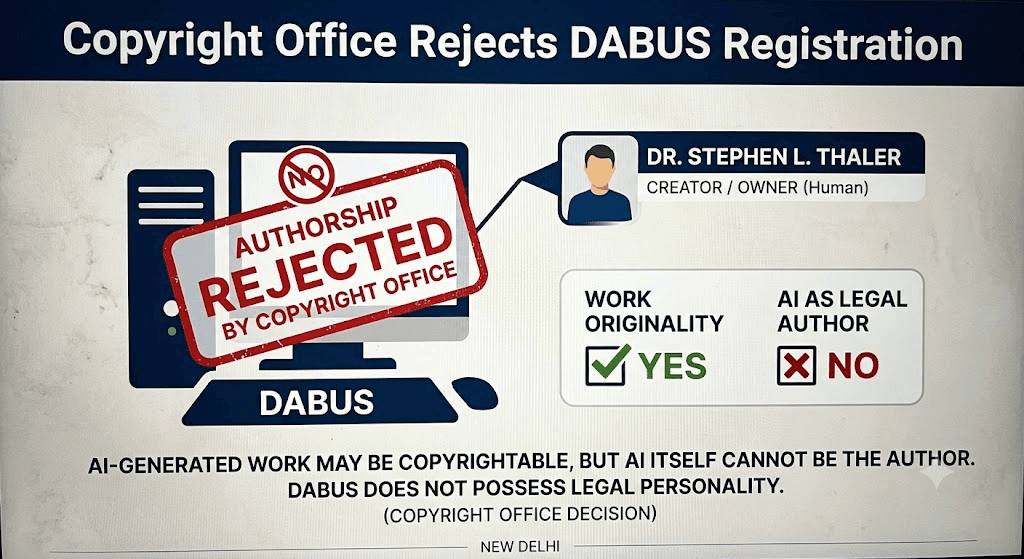
The Copyright Office has held that an AI-generated work may satisfy the originality requirement for copyright protection, but an artificial intelligence system itself cannot be recognised as the legal author under the Copyright Act, 1957.
Published on 12 September 2026 • 02:30 pm
Background
Dr. Stephen L. Thaler filed an application in May 2022 seeking registration of an artistic work titled "A Recent Entrance to Paradise." The application stated that the work had been autonomously generated by DABUS, an artificial intelligence system, and identified DABUS as the author while naming Dr. Thaler as the applicant and claimed owner.
DABUS, short for Device for the Autonomous Bootstrapping of Unified Sentience, is an AI system comprising interconnected neural-network modules. Thaler stated that he had supplied visual inputs, curated linguistic material and configured and trained the system, while the final visual composition was generated autonomously without real-time human intervention or a conventional text prompt.
Originality and Authorship Are Separate Questions
The Registrar rejected the suggestion that the work automatically lacked originality merely because it was generated using an AI system.
Applying the originality principles under Section 13 of the Copyright Act, including the standard discussed in Eastern Book Company v. D.B. Modak, the Office found that the particular arrangement and composition of the work contained sufficient independently generated creative expression.
The registration therefore failed not because the work was AI-generated, but because the applicant sought to attribute authorship to the AI system itself. The Registrar treated the question of originality as distinct from the question of who can legally be an author.
AI System Cannot Be the Legal Author
The applicant argued that DABUS was the immediate or 'operative' cause of the work because the system itself carried out the final generative process.
The Registrar rejected this approach, relying upon the 'mastermind' or effective-cause reasoning reflected in Burrow-Giles Lithographic Co. v. Sarony and Aalmuhammed v. Lee.
Section 2(d)(vi) of the Copyright Act, which deals with computer-generated works, refers to the person who causes the work to be created. On the facts placed before the Office, that person was Dr. Thaler and not DABUS.
DABUS Has No Legal Personality
The Registrar further noted that DABUS has no statutory recognition, proprietary status, civil personality or independent legal capacity under existing law.
Consequently, the AI system could not be treated as the first owner of copyright under Section 17 or validly assign copyright under Sections 18 and 19.
The Office therefore concluded that identifying DABUS as the author while claiming ownership through Dr. Thaler created a legal inconsistency that prevented the work from being entered in the Register.
Applicant Declined to Name Human Author
During the proceedings, Dr. Thaler was given opportunities to amend the application and identify himself as the author of the work.
The applicant declined to do so and maintained that DABUS should continue to be identified as the author, with Thaler being treated as its creator or controller.
The Registrar consequently held that the particulars identifying DABUS as author and Dr. Thaler as owner could not legally be entered in the Register.
AI Personhood Requires Legislative Intervention
The Copyright Office also rejected the argument that a Parliamentary response concerning protection for AI-generated works amounted to recognition of AI systems as legal authors.
According to the Registrar, existing intellectual-property law may accommodate copyright protection for works generated using AI, but this does not confer legal personality or independent authorship upon the AI system itself.
The Office held that whether autonomous AI systems should eventually receive legal personality or independent authorship is a matter of legislative policy for Parliament and cannot be created through administrative interpretation of the existing Copyright Act.
Decision and Legal Position
The Copyright Office ultimately rejected the registration application because DABUS could not legally be recognised as the author of the work.
At the same time, the Registrar's reasoning makes an important distinction between the copyrightability of an AI-generated work and the legal identity of its author. The work was found to satisfy the originality requirement under Section 13.
The decision therefore leaves open the possibility of copyright protection for sufficiently original AI-generated works where authorship can legally be attributed to a qualifying human person under the existing statutory framework.
"DABUS is not a natural or juristic person recognised in law and cannot be entered as author under Section 2(d)(vi)."
— Registrar of Copyrights
Key Highlights
AI Work Can Be Original
The Copyright Office did not reject the work merely because it was generated using artificial intelligence and found that it satisfied the originality requirement.
AI Cannot Be the Author
DABUS cannot be recognised as a legal author because it is neither a natural person nor a juristic person recognised by law.
Human Authorship Matters
Section 2(d)(vi) attributes authorship of a computer-generated work to the person who causes the work to be created.
Legal Personality Requires Parliament
Recognition of AI systems as independent legal authors or persons would require legislative intervention rather than administrative interpretation.
Legal Significance
The decision draws an important distinction between originality and legal authorship in the context of artificial intelligence. It indicates that AI-generated works are not automatically excluded from copyright protection, while affirming that existing Indian copyright law does not recognise an AI system itself as an author. The ruling also highlights the limits of administrative interpretation where recognition of AI personhood or independent authorship would require legislative action.
Case Details
Case
In the matter of Diary No. 9356/2022-CO/A
Court
Copyright Office, New Delhi
Bench
Registrar of Copyrights
Date
2026
This article provides an editorial summary of the Copyright Office's decision and is intended solely for informational and educational purposes. Readers should consult the official decision and the Copyright Act, 1957 for authoritative guidance.